You wait patiently. You indicate a high resistance. Price then breaks above it, and you go into the trade hoping for a good move.
Only to be reversed in a brief period and to find yourself at a loss.
It is not a misfortune. It is a fake out, one of the most prevalent trading traps.
Here’s the reality: The market does not move on its own. It trails, detects, and sieves participants.
It is crucial to realize the difference between a legitimate breakout and a fakeout so that you can trade clearly rather than confusingly.
What is a Breakout?
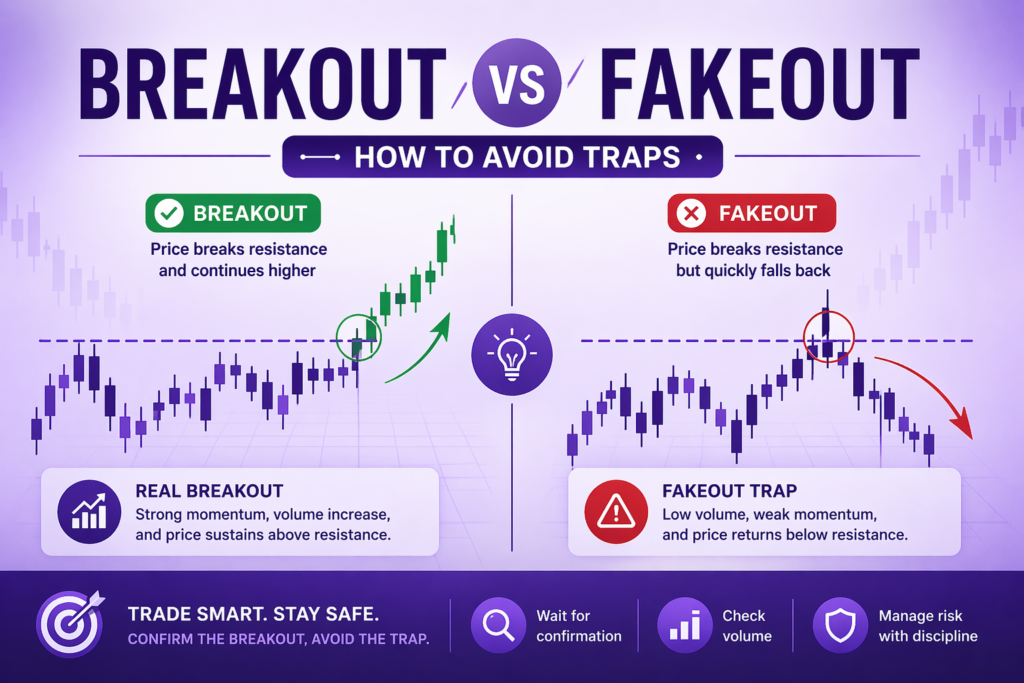
A breakout occurs when the price goes past a significant level and maintains that position.
Not only is it about passing a stage. It is on acceptance on a higher level.
A good breakout tends to exhibit three attributes:
- Price mounts pressure towards a level and then breaks
- The relocation is backed by a good momentum
- Breakout level is maintained at a price that is either higher or lower than the price
This implies that either buyers or sellers are dominating, and the market is willing to go in that direction.
What is a Fakeout?
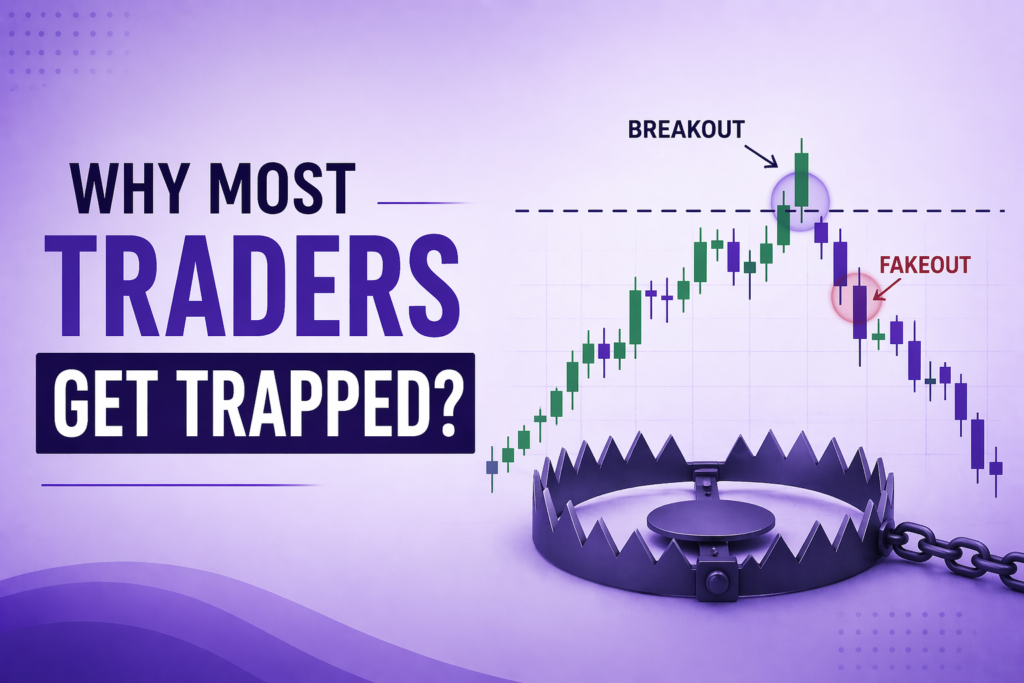
When a price breaks a level and does not follow through but instead turns around soon, it is a fakeout.
It appears to be a legit breakout at first sight. At that stage, a good number of traders come in. However, rather than continuation, there is an opposite movement of the market.
This is a trap.
Fakeouts are usually done due to:
- Traders are early entrants who lack confirmation
- There is not enough momentum behind the move
- These levels are used by big players to establish liquidity
The consequence is the same, that is, confusion to the newcomers and losses to the unpunished traders.
Key Difference Between Breakout and Fakeout
Breakout and fakeout appear to be identical at first sight. Price breaks a major level, momentum builds, and it feels like the move has begun.
And the actual difference is not the breakout itself; it is the market’s behavior after the breakout occurs. Therein the clearness lies.
Price Acceptance vs Price Rejection
An actual breakout depicts acceptance. Price goes past the level and remains above or below.
Rejection is represented by a fakeout. Price rises above the level but soon returns, signaling no strength.
Continuation vs Reversal Behavior
In a true breakout, the market moves and keeps moving in a similar direction and there is a follow-through.
During a fakeout, the market turns around shortly after the breakout and usually catches off traders who made the early entry.
Strong Momentum vs Weak Movement
Strong price movement is typically in favor of breakouts and bears clear intentions of buyers or sellers.
Fakeouts are not always so strong. The transition seems feeble, wobbly, and unsustainable.
Structure Alignment vs Market Noise
An actual breakout is in line with the general market structure and the direction of the trend.
In uncertain or lateral conditions, where price movement is not directional, a fakeout typically occurs.
Confidence vs Confusion
A real explosion makes sense. Pricing is presented more easily, and decisions are formal.
A fakeout leaves an impression. Price volatility causes emotional, reactive trading.
Why Most Traders Get Trapped?
Most traders do not lose because they are unaware of breakouts. They fail as they go too directly with no confirmation, structure, or discipline.
Entering Trades Without Waiting for Proper Confirmation Signals
Countless traders come in immediately when the price breaks a level, even before they can determine whether the market accepts the breakout.
Ignoring the Overall Market Trend and Trading Against Direction
Breakout trades made without trend-checking result in low-probability setups, particularly when the overall market is trending against the setup.
Trading in Sideways Markets Where Breakouts Often Fail
With range-bound conditions, the price often breaks levels in the short term and then backtracks; thus, breakout trading is ineffective, and the probability of a trap is high.
Overtrading and Chasing Every Visible Breakout Opportunity
Attempting to trade all breakouts leads to poor decision-making; not all of these setups are valid or worth trading in a real market environment.
Lack of Risk Management and No Defined Exit Strategy
In the absence of appropriate stop-losses and planning, traders have to keep losing positions open longer, turning small errors into bigger losses on fakeouts.
Emotional Decisions Driven by Fear of Missing Out
FOMO compels traders to make hasty entries without analysis, making them easy targets for fakeouts on abrupt, deceptive price changes.
How to Identify a Strong Breakout
A powerful breakout does not simply concern the price crossing a level. It is of power, affirmation, and ongoing motion above all.
- Price consolidation and accumulation of pressure occur with a crucial potential break of the price
- Breakout occurs during powerful, decisive price action, not low and slow candles
- Breaking out above resistance or below support, the price sustains above resistance or below support
- Breakout is in line with the general market trend in favor of higher probability
- During the breakout, there is an upsurge in volume, which is a good sign of involvement
- Re-test of the breakout level, which is accepted by the market
- Little rejection upon breakout, which signifies stability
How to Avoid Fakeouts?
This is not about avoiding fakeouts due to market predictions. It is concerning the better decision-making process.
These are important principles that can be used:
- Wait till it is confirmed rather than rushing in
- Watch the price behavior on the breakout
- Trading in all sideways or uncertain market conditions should be avoided
- Concentrate on quality arrangements rather than quantity
- Breakout + trend direction
Such minimal adjustments in strategy can make a big difference in your consistency.
Why This Concept is Important in Stock Market Learning
The concept of breakouts and fakeouts does not revolve around a single tactic. It deals with knowing how the market reacts around critical levels.
This concept improves:
- Entry timing
- Risk management
- Decision-making confidence
It also assists you in shunning emotional trading which is the major cause of losses.
This is why it is a fundamental component of systematic Stock Market Learning.
Learn Breakout Trading the Right Way
It is one thing to read about breakouts. It is one thing to understand them in practice in the marketplace.
Aceink, led by SEBI-registered stock market analyst Bharath Shankar, is dedicated to helping beginners and investors in exploring the key differences between breakouts and fakeouts in the stock market in his Free Stock Market Webinar held every Sunday.
During this session, you get to know how to:
- Determine good breakout configurations
- There are pitfalls and canards to evade
- Understand the market behavior effectively
- Trade in direction and pattern
This will help you become more confident when you are in a state of confusion.
Conclusion
Breakouts are good, whereas fakeouts are bad. The distinction between the two has been in how you read the market and how patiently you take action.
Your trading naturally improves as you stop reacting to each move and wait for confirmation.
Aceink can help you achieve clarity through its Stock Market Free Workshop, where you learn how to deal with real market situations in a disciplined, structured manner.