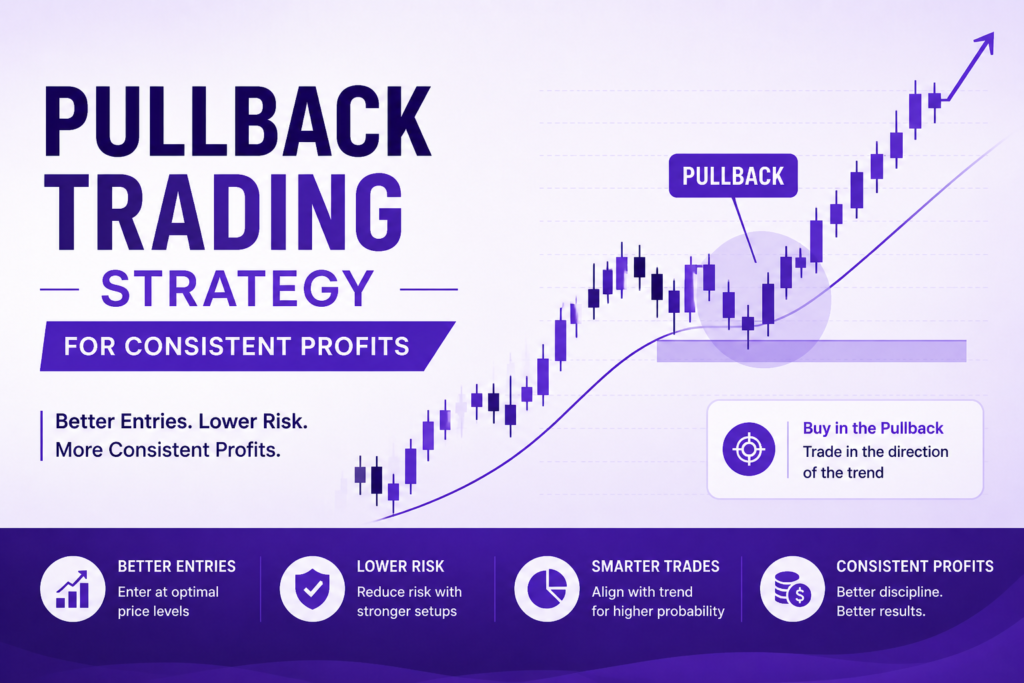
Many traders make one common trading mistake: they chase prices after a big move. Once a stock is already on a roll, they jump in and get excited, only to see it pull straight back. This usually results in poor entries and unwarranted losses.
This is where pullback trading comes into play. Rather than following momentum, pullback trading teaches you to wait until price breaks back, providing a superior entry into the prevailing trend. It is among the most feasible tactics employed by disciplined traders, as it enhances entry quality and risk management.
When used correctly, pullback trading can help traders build a pattern of consistency by trading slowly rather than hastily.
What is the Pullback Trading Strategy?
Pullback trading is the art of waiting to trade during a short-term backlash in the trend to exploit the trade.
A pullback is not a backward step. It is nothing but a momentary action opposite to the direction before the trend moves in the same direction.
To illustrate, during an uptrend, a price increases, then makes a temporary decrease and proceeds to increase. That short-lived downturn is the pullback.
This strategy is quite simple in nature which is to enter at improved prices rather than play prolonged moves.
Why Pullback Trading Works
Markets do not progress in a linear manner. Price movements in a strong trend go through periods of momentum and correction.
Pullbacks occur due to traders taking profits, short-term sellers trading or the market taking a break. However, a continuation by the trend will make buyers tend to revisit and continue with the trend.
This creates opportunity.
Pullback trading is effective as it enables traders to:
- Move nearer to support areas
- Reduce stop-loss distance
- Improve risk-reward ratio
- Avoid emotional entries
This renders it one of the most powerful ideas in feasible trading.
How to Identify a Pullback
A pullback ought to be discerned in a clear trend. In the absence of trend, there is no pull back strategy.
These are what to look out:
Strong Existing Trend
- It should already be on a decisive uptrend or downtrend on the stock
- During an uptrend, the highs and lows should be higher
- When a down trend is observed, seek lower highs and lower lows
- This affirms market trends
Temporary Retracement
The pullback must not be aggressive.
When price falls too far, it might be indicating that it is weak instead of a healthy pullback.
Important levels are typically honored by healthy pullbacks.
Reaction at Important Levels
Good pullbacks frequently occur around:
- Support and resistance areas
- Trendlines
- Moving averages
These stages enhance the chances of carrying on.
Types of Pullback Trading Setups
The pullbacks may have various forms depending on the market structure.
Support-Based Pullback
During an uptrend, the price tends to be drawn back to the earlier support and then continues to move upwards.
This is among the most sure pullback systems since support is a demand area.
Moving Average Pullback
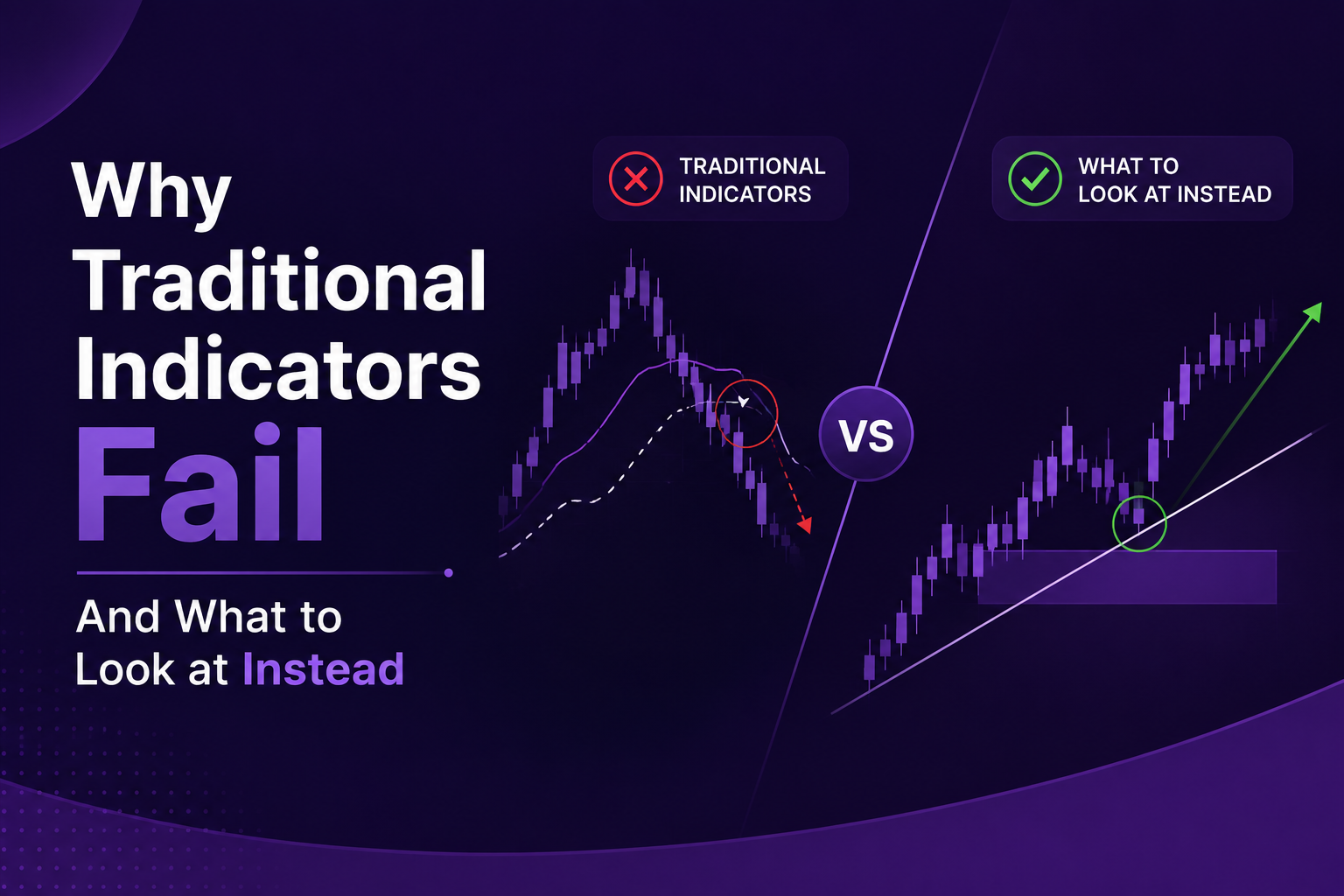
Several traders apply moving averages such as 20 EMA or 50 EMA as dynamic support in the pullbacks.
In case of a revival in price, which moves towards these averages and is strong, continuation becomes probable.
Trendline Pullback
Trendlines are usually honored in trending markets.
High-probability can be formed by a reversal to the trendline and a vigorous bounce.
Step-by-Step Process to Trade Pullbacks
A systematic procedure enhances uniformity and elimination of emotional decision-making.
Identify the Trend First
Always begin with the pullback. Begin with the direction of trends.
Lack of a powerful trend leaves the pullback at a disadvantage.
Mark Key Support Zones
Locate price responsive areas.
These may be the past support, moving averages or trendlines.
Wait for Price to Retrace
Patience is critical.
Never enter when price continues to move aggressively. Wait to be retruded to your zone.
Look for Confirmation
This can be proved by:
- Strong bullish candle
- Rejection candle
- Breakout after pullback
This is an assurance that consumers are coming back.
Plan Entry and Risk
Before entering:
- Define entry
- locate support below stop-loss
- Define targets according to continuation of the trend
This creates structure.
Common Mistakes in Pullback Trading
Pullback trading is not as easy as it may seem.
Confusing Pullback with Reversal
A pullback is not necessarily a retracement. In some cases, it marks the turnaround of the trends.
This is the reason why confirmation is important.
Entering Too Early
Many traders do so during the fall itself rather than stabilizing the price.
This increases risk.
Ignoring Trend Strength
When trends are weak, pullbacks are weak.
Concentrate on robust and sound market structure.
No Risk Management
Even good pullback configurations do not work.
Risk control has been critical.
How to Improve Pullback Trading Accuracy
To better this plan, it needs monitoring and punishment.
- Target good trending stocks
- Combine support and moving averages
- Awaited clear price confirmation
- Use weak pullbacks wisely
- Use pre-planned entries and exits
Process and not speed bring about consistency.
Why Pullback Trading is Important in Stock Market Learning
Pullback trading educates patience, timing and well-organized entry.
It can aid traders to realize that they can make better entries through waiting rather than pursuing.
This renders it a significant component of Stock Market Learning, in particular, to novices who find it difficult to be emotionally in the market.
Why Choose Aceink for Free Stock Market Workshop and Become Expert?
Aceink is the leading Stock recommendation company and is the brainchild of SEBI Registered Stock market Analyst Bharath Shankar, who assists traders to gain practical understanding of the market by means of structured learning, live market training given as well as strategy-based recommendations, which aims at enhancing decision-making and trading discipline.

Learn Practical Pullback Strategies
Know how pullbacks can be constructed in actual market environments and how to recognize better timing quality setups.
Build Strong Market Understanding
Master the trend structure, price action, and support areas in a simplified and practical manner.
Avoid Common Trading Mistakes
Aceink is concerned with assisting traders in reducing emotional decision-making and improving execution discipline.
Learn from SEBI Registered Stock Market Analyst
Learn directly from Bharath Shankar and see how disciplined traders approach the market.
Learning Opportunity Free Stock Market Learning
Aceink Free Stock Market Webinar assists traders in building solid foundations and learning to trade in real markets.
Conclusion
One of the most viable strategies is pullback trading, which trains patience and requires higher entry timing. Rather than pursuing price, it assists the traders to wait until they have chances where the risk is contained and the likelihood is high.
Aceink assists traders to learn this strategy in its Free Stock Market Webinar, where pullback trading, market structure, and implementing the strategy is shown in practice market knowledge. When you are willing to become more disciplined in trading and make better decisions, learning to trade a pullback may be a powerful move.