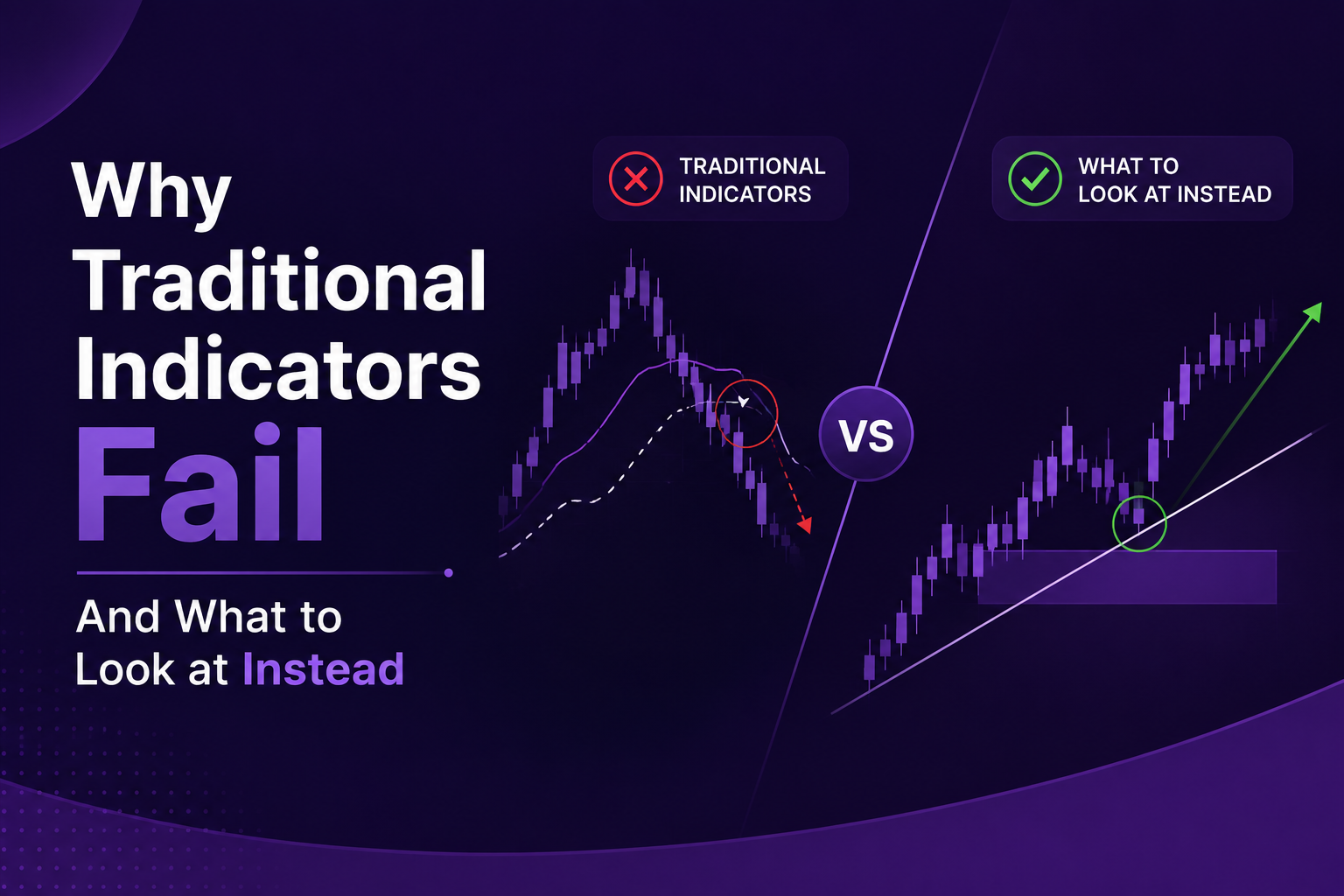

Most beginners do not lose money because they choose the wrong stocks. They fail because they are unaware of the market direction.
They purchase during down periods, sell during up periods, and experience stagnation in the sideways markets.
The truth is this, however: When you can spot the trend in the proper way, half the trouble of trading is already gone.
The basis of trading is the trend. In its absence, all decisions would be guesswork. We can take a closer look at how to recognize the right trends, as real traders do.
What is the trend in Stock Market?
A trend merely shows how the market is progressing.
The number of possibilities is only three:
- Uptrend
- Downtrend
- Sideways
Each stock, each index, must always be either of these types.
It is not your responsibility to forecast the market. It is your task to find out what it is doing at present.
This is what Stock Market Learning is all about.
Types of Trends in the Stock Market
You should be clear about what each trend really looks like in real market conditions before identification.
1. Uptrend (Higher Highs, Higher Lows)
When the price is always increasing, then this is an uptrend.
How to Identify:
- Price makes higher highs
- Price makes higher lows
- Pullbacks are shallow
What It Means:
- Customers are on top
- Demand is strong
- The market has good sentiments
Strategy: Concentrate on acquisition opportunities.
Novice Error: Attempting to sell due to a feeling of high price.
2. Downtrend (Lower Highs, Lower Lows)
A downward trend is when the price is moving consistently lower.
How to Identify:
- Price makes lower highs
- The price is lowering
- Rallies are weak
What It Means:
- Sellers are in control
- Supply is strong
- Sentiment in the market is unfavorable
- Strategy: Focus on selling or avoid buying
Beginner Mistake: Purchasing all the dips without verification.
3. Sideways Market (Range-Bound)
Herein lies the bane of the amateurs.
How to Identify:
- No definite upper highs and lower lows
- There is a range of price movement
- Breakouts often fail
What It Means:
- No noticeable buyer or seller control
- The market is in consolidation
- High uncertainty
Strategy: Do not overtrade or trade cautiously.
Novice Trap: False breakouts.
Step-by-Step Process to Identify Trend
Read market direction easily by following a simple process.
Start with a Higher Timeframe for Clarity
Always start with a longer time frame, such as daily charts, to filter out the noise and get a clear picture of the overall direction the market is moving before looking at smaller movements.
Observe Price Structure Carefully
Pay attention to the price trend. Determine which trend direction it is, whether higher highs, lower lows, or making highs within a range.
Mark Key Support and Resistance Zones
Mark significant levels at which the price responds consistently. The zones assist in either proving that the market is moving or merely moving within a range in the same direction.
Align Trend with Market Behavior
Determine whether the price is honoring the trend determined. Regular motion towards the same direction determines strength, and frequent irregular motion tends to indicate a sideways state.
Wait for Confirmation Before Acting
Trades are not to be hastened into. A good way to determine where to stay in the market is to wait till you get a clear confirmation such as breakout, pullback or continuation.
Common Mistakes While Identifying Trend
The novices commit the following errors even after learning the basics:
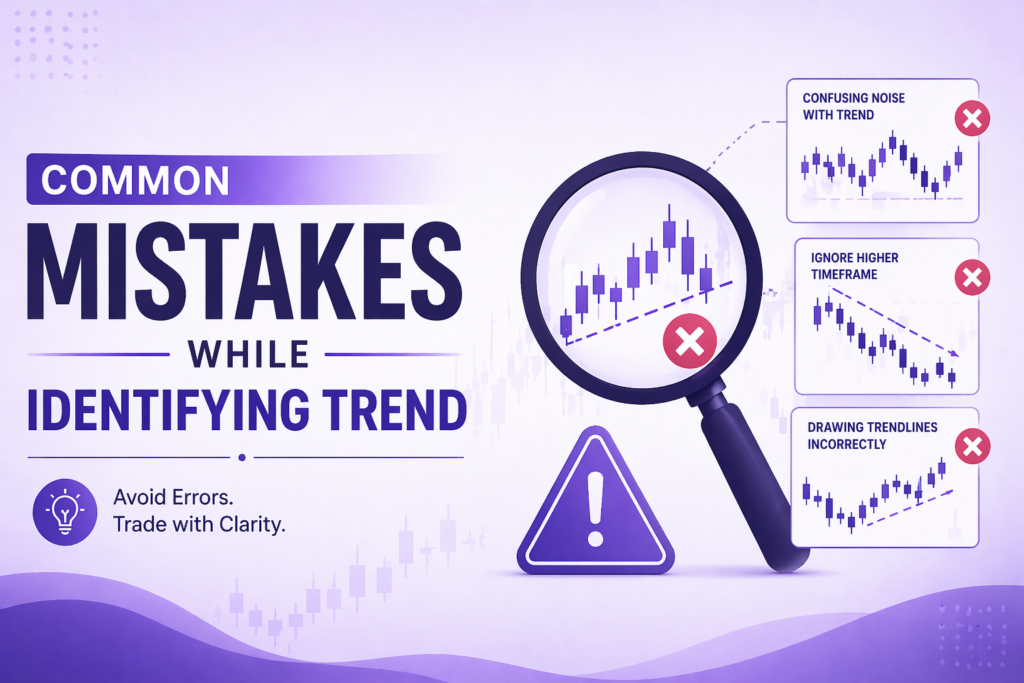
- Taking very small time periods
- Lack of consideration of general market structure
- Conflating pullback with reversal
- And trading in cross-sided markets
- Changing bias frequently
These errors result in incorrect entries and losses.
How to Improve Trend Identification
To improve, work on processes not shortcuts.
- Reading charts: Everyday
- Pay attention to price structure, and not indicators
- Keep it to a single time period
- Examine real-life examples on the market
- Avoid overcomplicating analysis
The identification of trends is enhanced through observation and experience.
Why Proper Stock Market Learning Matters
Theoretically trend identification is easy, however the real markets behave otherwise.
Charts are not necessarily clean.
Signals do not necessarily stand out.
In this, structured Stock Market Learning comes into play.
Instead of guessing, you learn:
- The formation of trends in actual circumstances
- When trends fail
- What to do with sideways markets
Learn Trend Identification in Free Stock Market Webinar
To know trends right, you must have more than theory; you must have market understanding.
Aceink, headed by SEBI-registered stock market analyst Bharath Shankar, conducts the Free Stock Market Webinar, helping you completely understand the concept of trends, including Uptrend, Downtrend, and Sideways.
During this lesson, you will study:
- How to spot uptrend, downtrend, and sideways markets
- How not to make the most frequent errors
- How to work out your trades in the market direction
- How to read stock charts step-by-step
Conclusion
Knowing trends is not merely a theory; it is a fundamental trading practice that will distinguish between an unplanned move and a planned action. Once you learn how to read the market direction properly, you become more confident and diminish the number of errors. But guided practical learning offers real clarity.
Led by SEBI-registered stock market analyst Bharath Shankar, Aceink helps you understand developments in real market scenarios through its Free Stock Market Webinar. You are not confused but rather gain a step-by-step understanding of how markets move and how to match your trades to them.
This is where you want to start, willing to learn the Stock Market.