One of the most popular trading styles in the stock market is breakout trading, which emphasizes momentum and expansion. Price moving strongly across a significant level is likely to generate great opportunities for traders who know how to find it and execute it correctly.
However, the challenge here is that not all breakouts are successful. Novices jump in too soon, get caught in fakeouts, and become discouraged by the approach. Rarely is the issue the breakout itself. The timing, confirmation, and understanding of the problem are normally the issue.
This guide simplifies the understanding of breakout trading in a way that you can comprehend how actual breakout setups are as well as how disciplined traders go about them.
What does it mean by Breakout Trading Strategy?
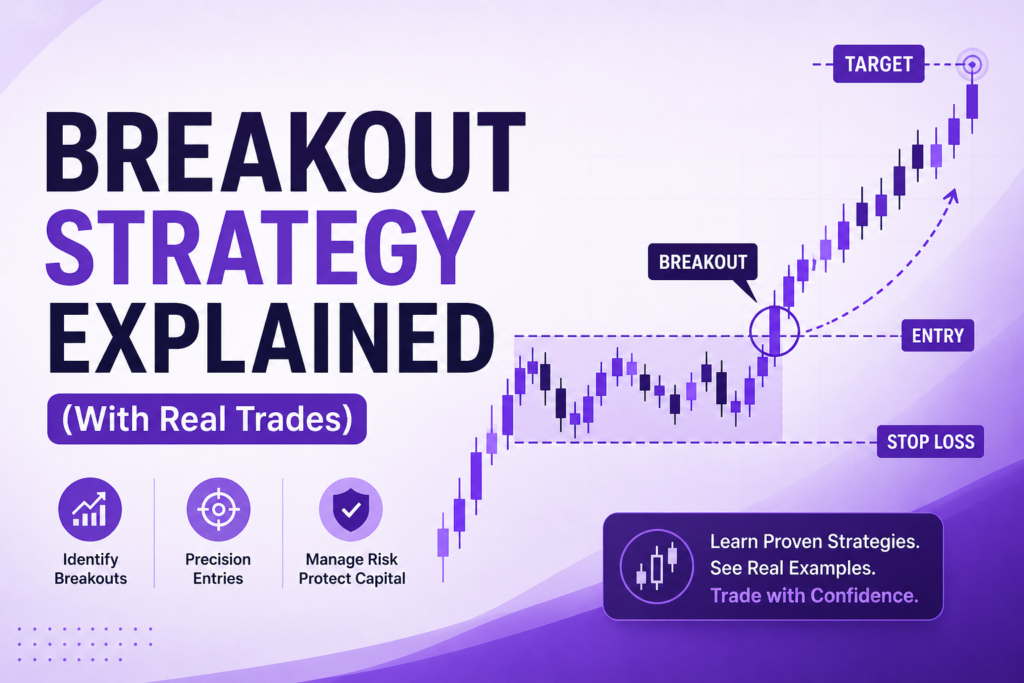
A breakout plan focuses on identifying price movement beyond a significant support or resistance point and trading the ongoing move.
Simply, a price breaking an important level it was previously confined to generally signals a shift in momentum, and a larger movement might occur.
Breakouts usually occur after consolidation, as the market accumulates pressure within a range. After the release of such pressure, a price usually moves very sharply in either direction.
Why Breakout Trading Works
Breakout trading is effective because markets fluctuate in their stages of contraction and growth.
During consolidation, buyers and sellers are equalized. Price is within a narrow range. Under mounting pressure, one party ends up controlling the situation, leading to a breakout.
This change develops momentum.
The advantage of breakout strategies is that they enable traders to take new moves and avoid late entries into already stretched trends.
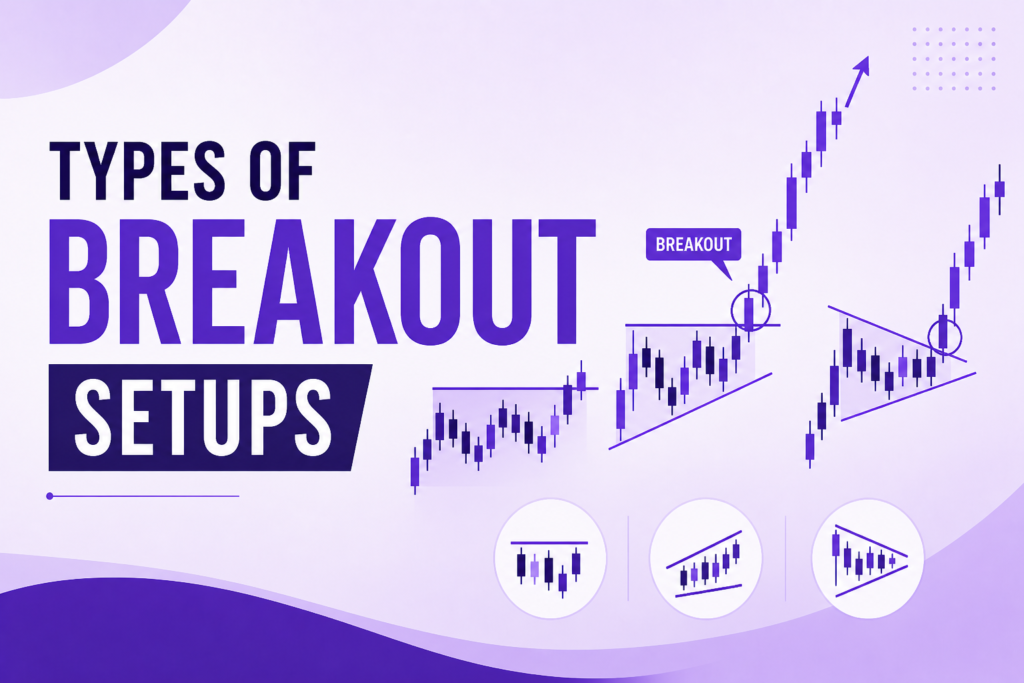
Types of Breakout Setups
In various market structures, breakouts may occur. The knowledge of such arrangements enhances the quality of decisions.
Resistance Breakout
This occurs when the price goes above a strong resistance area.
It shows that buyers have already taken up the pressure to sell and the pressure could be further pushing the price higher.
This is among the widely used bullish breakout arrangements.
Range Breakout
When a price operates within a narrow band and then explodes out of it, it can build considerable momentum, as there has been mounting pressure.
In short-term and swing trading, range breakouts are very popular.
What is Support Breakdown (Seller Side)?
A support breakout occurs when the price moves below and sustains the support zone.
There has been an increase in selling pressure and sellers have taken over the market. As weakness continues, such setups often create new downside opportunities.
When markets are weak, support breakdown provide bearish trading opportunities.
Step-by-Step Process to Identify Breakouts
Emotional and random entries are prevented through a structured process.
Identify Strong Support or Resistance
Marking significant price levels that have been responded to multiple times is the initial step.
The higher the level, the better the potential for a breakout.
Watch for Consolidation Near the Level
It is a good reform when prices converge around a point since it means that the pressure is mounting.
Narrow-range trading results in frequent breakouts.
Wait for Breakout Confirmation
Breakout is not proven when the price touches or goes beyond the level. Confirmation occurs when the price extends above the level and remains above it. A lot of novices fail here.
Observe Volume Participation
Volume contributes to breakout analysis. The breakout with good participation is usually more stable than the breakout with poor activity.
Plan Entry, Stop-Loss, and Target
Always define before entering:
- Entry level
- Stop-loss placement
- Target zone
This maintains the trade organized.
Real Trade Example: Resistance Breakout
Well, to give a practical example.
Suppose a share that is trading between ₹480 and ₹500 in three weeks. Price attempts to test ₹500 several times without any success.
This is pressure-testing. After some time, the price breaks above ₹500 with a strong candle and ends at 510. Price retests ₹500, and the following day, the price holds.
This retest substantiates the breakout.
A trader coming in after confirmation has the following:
- Clear breakout structure
- Better risk control
- Excellent chance of survival.
This is the discipline of breakout traders that approach the market.
Real Trade Example: Range Breakout
Consider a stock trades at ₹950-980 over several sessions.
Price will stay within this range as volatility diminishes.
Finally, the price breaks above 980 and has a good momentum and maintains above.
This breakout means that the consolidation stage is over and growth has begun.
Traders usually get in once it is confirmed, then refer to the previous range to set a stop-loss.
Common Mistakes in Breakout Trading
Breakout trading is easy to use, but it is easy to make simple mistakes that can reduce the consistency.
Entering Too Early
Before the breakout is established, many traders get in.
This leads to higher occurrence of fakeouts.
Ignoring Market Trend
The breakouts against the general trend are less likely.
The alignment of trends enhances quality.
Trading Weak Levels
Not every level is significant. The lowly tested levels tend to give weak breakouts.
No Risk Management
Even powerful breakouts are not always successful.
Losses that do not have stop-loss are hard to manage.
How to Avoid Fakeouts in Breakout Trading
Trading includes fakeouts and can be minimized.
- Wait till the candle is closed above breakout level
- Note retest and support holding
- Break outs: do not occur in weak, sideways markets
- Make emphasis on proper construction and neat installations
- Volume is another confirmation
Such rudimentary filters enhance the quality of trade.
Why Breakout Trading is Important in Stock Market Learning
Breakout trading trains traders on how to spot expansions of momentum, the behavior of prices as well as how to sell better.
It assists traders to build patience since the finest breakout trades can be a process of waiting to get the appropriate setup and confirmation.
This renders it a powerful section of feasible Stock Market Education.
Why Choose Aceink for a Free Stock Market Workshop and Become Expert?
Aceink is the best Stock recommendation company, headed by SEBI-registered stock market analyst Bharath Shankar, that assists traders in understanding breakout strategies, market structure, and the disciplined performance of the trade through structured stock market education and practical learning.
Learn Practical Breakout Strategies
Learn how actual breakout configurations develop and how to pick quality trades at a more opportune time.
Build Better Trade Discipline
Understand how patience and confirmation enhance breakout accuracy and minimize unnecessary breakout loss.
Understand Market Structure Clearly
Aceink pays more attention to practical chart reading and structured decision-making than to random market tips.
Learn from SEBI Registered Stock Market Analyst
Learn under Bharath Shankar’s guidance and discover the disciplined breakout-trader’s approach to the market.
Free Stock Market Learning Opportunity
Aceink Free Stock Market Webinar assists traders in establishing a strong foundation in breakout trading and in actual market operations.
Conclusion
Breakout trading is one of the best strategies because it targets momentum and growth. However, that is not the secret to success in all breakouts. It is knowing which breakouts are good and which are traps.
Aceink assists traders in gaining such clarity by teaching breakout strategies, market behavior, and trade execution in its Free Stock Market Webinar using practical knowledge. Learning how to break out of a trade can go a long way toward enhancing confidence and market timing.